
Peng Bo, researcher at the Ministry of Commerce International Trade Economic Cooperation Research Institute and Director of China Business Think Tank Theory Research Department, delivered a report titled "The Sound of Glacier Melting in the Distance—Analysis of China-US Trade War and Future Prospects."
From a professional and in-depth perspective, he first reviewed the global tariff war initiated by Trump under the name of "reciprocal tariffs."
Regarding the current tariff situation between China and the US, Researcher Peng pointed out that US tariffs on China have a complex structure. These include basic rates (MFN rates), reciprocal tariffs (10%), fentanyl tariffs (20%), 301 tariffs (listed items), 232 tariffs (listed items), and anti-dumping duties (if applicable).
China's tariffs on the US consist of basic rates (MFN rates), additional tariffs on listed items, and 10% reciprocal tariffs.
Dr. Ning Jingxin, Assistant Professor at the University of International Business and Economics, calculated that within 90 days, the arithmetic average tariff from the US to China is 53.07%. China's arithmetic average tariff on the US is 32.94%. These figures clearly reflect the impact of tariff measures on bilateral trade.
On how to assess China-US economic negotiations and future directions, Researcher Peng offered seven insights:
His recommendations for businesses:

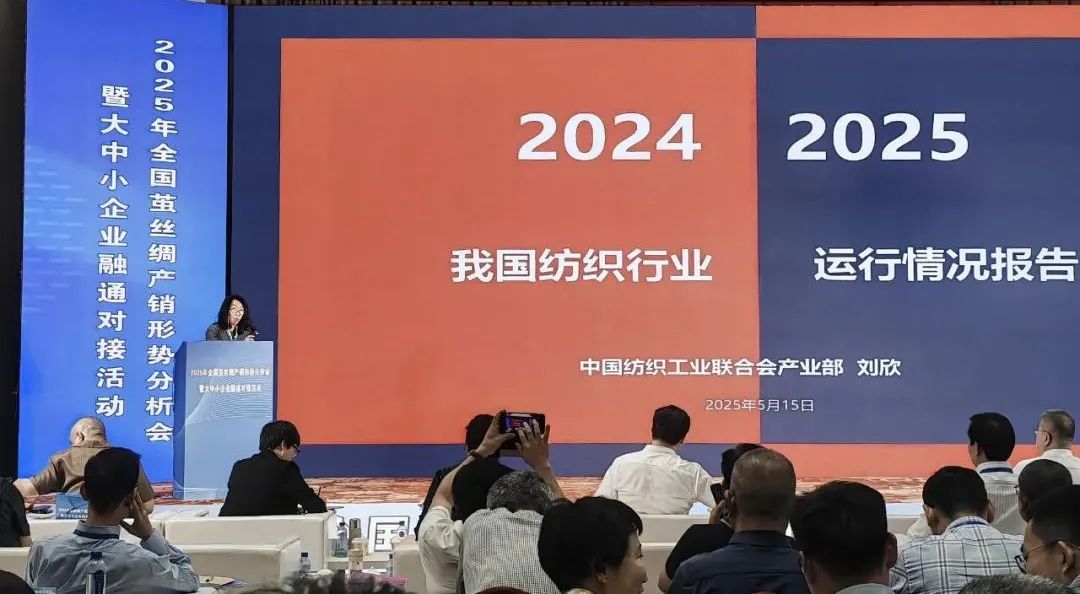
Liu Xin, Director of the Industrial Department of China Textile Industry Federation, presented a comprehensive report on the textile industry's performance and outlook.
In 2024, the global economy showed weak recovery with significant divergence. Manufacturing was relatively stable, but consumer markets remained sluggish. Despite occasional signs of warming, the overall situation remained weak. Global inflation pressure eased somewhat.
Against this backdrop, China's macroeconomic policies continued to exert force. The national economy remained generally stable and positive. GDP grew by 5.0% year-on-year. Economic vitality steadily recovered. Consumption continued to play a strong role in driving the economy.
China's textile industry showed good resilience. The overall economic operation recovered positively. Both supply and demand achieved steady growth. Production, sales, and profit levels all improved:
In 2025, global economic uncertainty has significantly increased. Growth momentum is insufficient.
The external environment has become more complex, severe, and uncertain. Trump administration policies have triggered new changes in the global political and economic landscape. Major power relationships and world order face adjustment. Tariffs and investment barriers have increased.
Although China's economy continues to recover, with domestic demand picking up, export growth has slowed. In the first quarter of 2025, domestic macroeconomic policies became more active. Existing and new policies continue to show results. Market expectations and confidence are gradually improving.
Expanding domestic demand has endogenous driving force. As relevant policies work together, market demand expectations will continue to improve. This will provide the textile industry with broad domestic market space and policy support.
Secretary-General Liu Wenquan of China Silk Association delivered a keynote speech on industry development in 2024-2025, comprehensively summarizing industry operations and analyzing challenges and opportunities.
Latest statistics from the National Bureau of Statistics show that from January to March 2025, silk production by enterprises above designated size increased by 0.88% year-on-year. Spun silk production decreased by 16.95%. Silk fabric production increased by 1.04%. Silk quilt production decreased by 40.65%.
Latest statistics show that from January to March 2025, operating income of enterprises above designated size decreased by 2.71% year-on-year. Total profits decreased by 19.96%. Finished product inventory increased by 9.99%. Total losses increased by 18.96%. The industry loss ratio increased by 4.52 percentage points year-on-year.
The latest monitoring data from the Ministry of Commerce shows that from January to March 2025, sales of 50 silk sample enterprises totaled 917 million yuan, down 0.13% year-on-year. Sales for the first three months were 306 million yuan, 303 million yuan, and 308 million yuan, respectively, representing year-on-year changes of -4.9%, +8.6%, and -3%.
Global silk trade is generally good but performance varies. The EU and US continue to decline. India has achieved relatively rapid growth.
The silk industry's revenue growth rate is 1.79 percentage points higher than the textile industry. However, profit growth is 14.97 percentage points lower than the textile industry. This shows increasing polarization among silk enterprises. The industry's economic operation remains under pressure.
With support from national policies to expand domestic demand and boost consumption, the potential of the domestic market will be further released. Technological innovation and consumption upgrading will become important engines driving industry economic growth. This will achieve coordinated efforts on both supply and demand sides. The industry is expected to continue its recovery trend.
Due to industrial layout adjustments and farmland control policies, mulberry field areas continue to decrease in some provinces and cities. Cocoon production has decreased significantly. The tight supply of silkworm eggs has not been effectively resolved.
As the scale of full-age artificial feed factory silkworm rearing further expands, especially with intelligent silkworm rearing equipment and artificial feed young silkworm co-breeding models gradually being promoted in major producing areas, plus cocoon purchase prices remaining high, silkworm farmers' production enthusiasm is high.
It is expected that national cocoon production in 2025 will remain basically stable. Fluctuations will not be too large. However, major producing areas still need to prepare early for extreme drought and flood weather, prevent pollution of mulberry fields by plant protection drone operations, and implement preventive measures against large-scale mulberry silkworm pests and diseases.
Due to inverted cocoon and silk raw material prices and insufficient domestic and foreign market demand, silk fabric and garment enterprises face increasing inventory pressure.
Currently, silk industrial enterprises have low expectations for the first half of the year. Overall production is relatively cautious. Most enterprises focus on fulfilling existing orders and strictly control spot inventory.
With the arrival of the peak sales season for silk clothing products, downstream sales enterprises' inventory replenishment needs will increase. This is expected to drive the gradual recovery of reeling and weaving enterprises' operating rates. However, it will still take some time to fully restore high-load production capacity.
It is expected that the production growth rate of major silk products may continue to slow in the first half of 2025. It may gradually return to stable growth in the second half of the year.
In 2025, the state is vigorously implementing special actions to boost consumption. It will arrange ultra-long-term special national debt to support trade-in of consumer goods.
Jiangsu, Sichuan and other provinces and cities have clearly included bedding in the subsidy scope. The subsidy standard is 15% of the final selling price. This is expected to drive some silk bedding sales.
The "immediate refund upon purchase" service measure for departure tax refunds has been promoted nationwide from multiple pilot locations. This will stimulate the consumption vitality of foreign travelers entering China. There are significant opportunities for national trend and intangible cultural heritage silk products.
As a large number of textile and apparel products shift from export to domestic sales, competition in the domestic market will inevitably intensify.
It is expected that in 2025, the silk domestic market will face more intense price wars from mid-to-low-end products of other fibers. Volume-based sales with thin profits will become the norm for silk enterprises' online and offline sales.
Global economic growth momentum is insufficient. International consumer demand is weak. This will constrain the recovery of demand for mid-to-high-end products over the long term.
The United States has always been the second largest market for domestic silk product exports. Annual export value to the US remains around $300 million, accounting for more than 20% of total export value.
It is expected that silk foreign trade export conditions will be severe in 2025. Enterprises need to closely monitor changes in tariff policies, adjust export strategies promptly, and implement necessary risk prevention and control measures.
This comprehensive analysis reveals the complex challenges facing China's silk industry in 2025. The industry operates in a tense global trade environment, particularly affected by US-China relations under Trump's second term. Despite external pressures, there are positive signs in domestic consumption and technological advancement.
The most noteworthy aspect is how the industry is adapting through diversification strategies - reducing dependence on American markets while exploring new opportunities in domestic and alternative international markets. The increasing polarization between successful and struggling enterprises suggests an industry in transition, with companies that embrace innovation and flexibility likely to thrive despite the challenging conditions.
The government's consumer stimulus measures and subsidies for specific silk products demonstrate recognition of the industry's cultural and economic importance. Moving forward, companies should focus on the recommended strategies: technological upgrading, market diversification, and integration of domestic and foreign trade approaches to navigate the uncertain terrain ahead.