
Run your finger across polyester twill and you will feel it immediately — a series of fine diagonal ridges, smooth and slightly cool to the touch. That texture is not decoration. It is the defining feature of twill weave, and it changes how this fabric behaves in ways most product descriptions never explain.
Polyester twill sits in a practical middle ground: more structured than basic polyester, more affordable than silk, and far easier to care for than cotton. But it has real trade-offs that are worth knowing before you buy.
Polyester twill is polyester fiber woven in a twill pattern — where horizontal threads pass over multiple vertical threads, then under one or more, shifting slightly with each row to create diagonal lines called wales.
That diagonal is not just visual. In a plain weave, each thread crosses over one, then under one, creating a grid where stress concentrates at every intersection. Twill staggers those crossings — similar to how bricks are laid with offset joints for wall strength. The load spreads across multiple threads instead of piling up at single points. This is why twill fabrics resist tearing better than plain weaves made from the same fiber.
A typical notation like “2/1 twill” means the horizontal thread passes over two vertical threads, then under one. Higher ratios like 4/2 produce more prominent diagonal ribs and a softer drape.
Polyester twill holds its shape through repeated washing better than plain-weave polyester. That shape retention — not generic “durability” — is the real advantage most descriptions gloss over.
If you are shopping online and cannot touch the fabric, here is what to expect: polyester twill feels smooth, with a slight sheen that catches light at angles. It is stiffer than silk but softer than canvas. The diagonal ridges give it a subtle texture you can feel when you run your hand across the grain versus with it.
For reference, a standard polyester twill runs about 170 GSM (grams per square meter) — that places it firmly in the mid-weight range. It is about 0.30 mm thick, roughly the weight of a sturdy dress shirt. Standard bolt width is 58 to 60 inches.
The fabric drapes moderately well. It will not cling to your body like silk or hang stiff like denim. Think of it as having enough weight to fall cleanly but enough structure to hold a pressed crease.
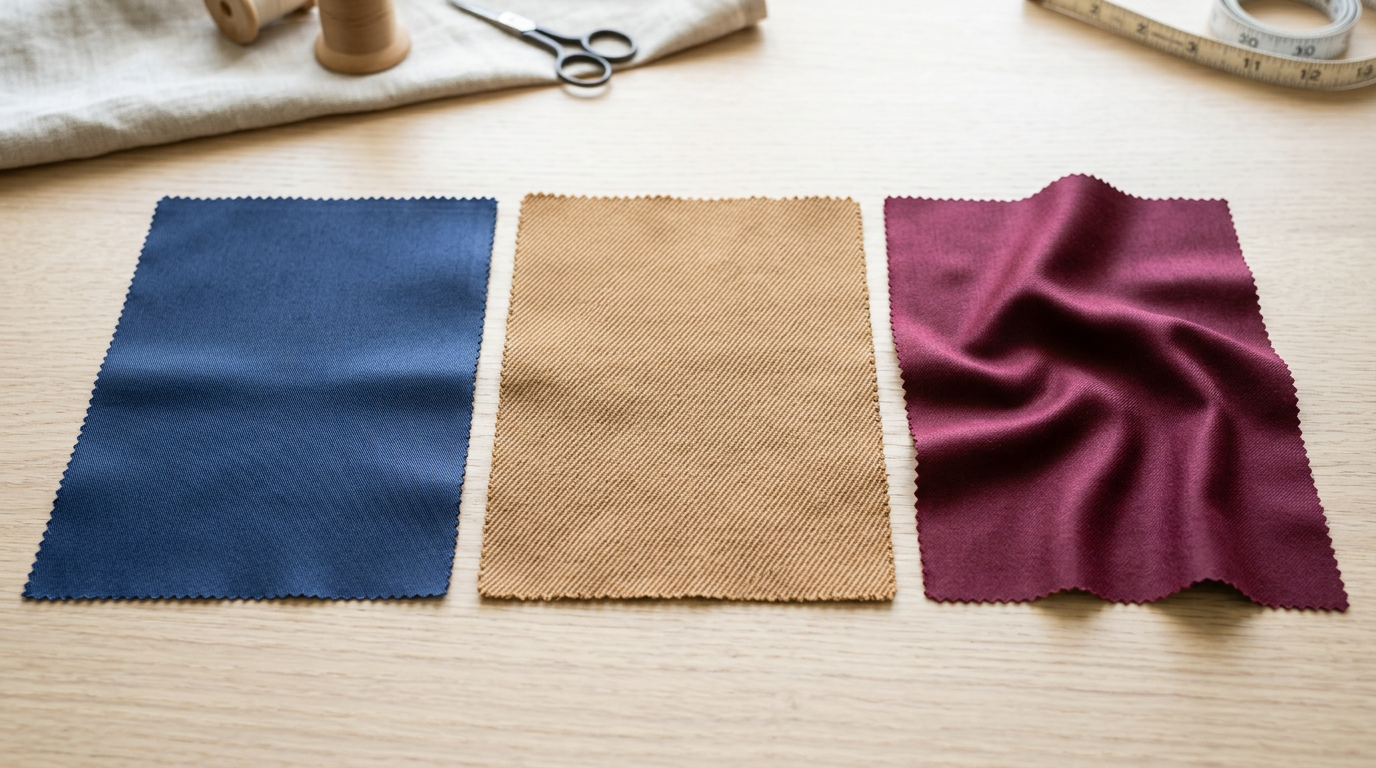
The weave is identical in all three — same diagonal pattern, same structural mechanics. The fiber is what changes the experience entirely.
Polyester twill resists wrinkles, dries fast, and keeps its shape wash after wash. It has a smooth, slightly shiny surface. The trade-off: it does not breathe well. In warm weather, you will notice it traps heat more than natural fibers. It also lacks stretch unless blended with spandex.
Cotton twill — think denim and chinos — feels softer and more textured. The diagonal ribs are more pronounced. It breathes better than polyester, making it more comfortable in heat, but it wrinkles easily, absorbs stains faster, and shrinks if you are not careful with water temperature.
Silk twill is the luxury end. Hermes scarves use silk twill for a reason — it combines drape with structure, feels cool against skin, and takes vivid dye colors. But silk twill costs much more and requires careful handling. For twilly scarves specifically, polyester twill offers a similar look at a fraction of the price, though the hand feel is noticeably different.
My honest take: polyester twill wins on convenience and cost. Cotton twill wins on comfort. Silk twill wins on feel and appearance. There is no universal “best” — it depends on what you are making and how much maintenance you are willing to do.
Polyester twill is low-maintenance, but one rule overrides everything else: keep the heat down.
Polyester is a thermoplastic fiber, meaning high temperatures can permanently change its shape. The threshold is 40 C (104 F). Above that, fibers can shrink or warp in ways that will not wash out.

Iron on low if needed, but polyester twill rarely wrinkles enough to require it. That is one of its genuine advantages.
Choose polyester twill when you need a fabric that looks polished, holds its shape, and requires minimal upkeep — uniforms, bags, structured scarves, home decor items like curtain panels and table runners.
Skip it for warm-weather clothing worn directly against skin. The breathability trade-off is real, and cotton or linen twill will serve you better there.
For printed accessories like scarves and headbands, polyester twill takes digital printing well and holds color vibrantly. Custom polyester scarves are practical for small-batch production at a price point that makes experimentation affordable. The fabric will not match silk twill’s hand feel, but for everyday use and frequent washing, it often makes more sense.